

Those who are new to solar power may find it challenging to understand the nitty-gritty of solar technology. And solar inverters are no exception. There are many types of inverters for solar, but it doesn’t have to be difficult. That means, you’ve come to the right place.
Although there are many types of inverters for solar power systems, narrowing them down is easier than you might think. If you know what type of solar system you’re installing, the type of inverter for solar becomes clear. Then, your selection will be based on size and power, quality, and price.
The size and power of all types of inverters for solar are based on your household power requirements. Then, the quality and price are based on what you require and can afford. In this article, review the primary types of inverters for solar. After that, uncover how to calculate your household power needs.
Continue reading to learn all you need to know about the various types of inverters for solar systems.
Many types of inverters for solar exist for the many varieties of solar systems
Throughout recent history, solar systems have clearly achieved an enduring favorable notoriety. As such, even the most basic solar systems have proven themselves beneficial and reliable.
While you may find many variations and custom options that go into a solar system, there’s an assortment of essentials to identify and explain in simple terms. As such, let’s take a walk through each part to understand the basic system and what essential solar components go into it prior to installation.
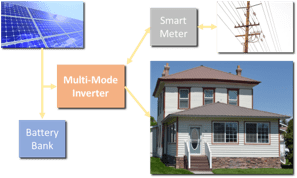
A sufficient solar system is a self-sustaining household solar system that also connects to the power grid. That means, it provides power from three sources: solar energy, battery bank backup, and your electrical utility grid.
Off-grid systems are enormously more complicated than common grid-connected solar systems. But, over 300,000 homes use them for their energy needs around the world. They know that when connected to the grid, they’re dependent on an external supplier for all their power. And when that power grid goes down, so does their power supply.
Check out the following components that make up a solar system. In this section, equip yourself with important knowledge while learning how to design a solar system. That way, you won’t run into surprises when purchasing you own off-grid solar system or hybrid solar system.
Solar energy independence from hybrid solar
When referring hybrid solar assets, you’re talking about a self-sustaining household electrical system that is also connected to your local electrical grid. That means, this system provides three sources of electricity: solar power, battery bank power, and power from your local electrical grid.
Keeping your connection to your power grid allows you to receive unlimited electricity. That means, if you use big equipment or appliances, your electrical system will support it without fault. And if the summer heat steeply rises, use air conditioning to your heart’s content and stay cool throughout the day.
In the following video below, Eric Martineau reveals more about how solar energy works. He’s the founder and owner of Just Get Solar. As you’ll see, Eric really knows his stuff!
Solar energy independence from off-grid solar
Starting with off-grid solar systems, over 300,000 homes use them for solar energy independence around the world. They know that when connected to the grid, they’re dependent on an external supplier, the utility company, for all their power. And when that power grid goes down, so does their power supply.
When preparing your off-grid solar system, you must determine the amount of energy your household requires. As such, calculate your daily and yearly energy usage. The reason for this is simple: off-grid solar systems are inherently variable – day vs. night and sunny vs. cloudy.
Understanding the daily and yearly power rhythms or usage curves of your family’s energy consumption is essential when planning an efficient and reliable system. Using your household power usage data, solar component size determination for your entire solar system will be accurate and adequate.
Knowledge of how power is used by your household is critical. For example, water pumps eat power fast. That means, showers, toilet flushing, and washing dishes drain power quickly. The steps to take are small, but mindful. When you understand these factors, small changes make all the difference
Now that you understand the two primary types of solar systems, let’s take a look at the three major types of inverters of solar.
Three major types of inverters for solar
When connected to the grid, your solar inverter synchronizes the frequency of the grid and inverter power to match the frequency for smooth operation. Solar Inverters are generally classified as conventional transformer-less inverters or transformer-based inverters.
MPPT or Maximum Power Point Tracker inverter
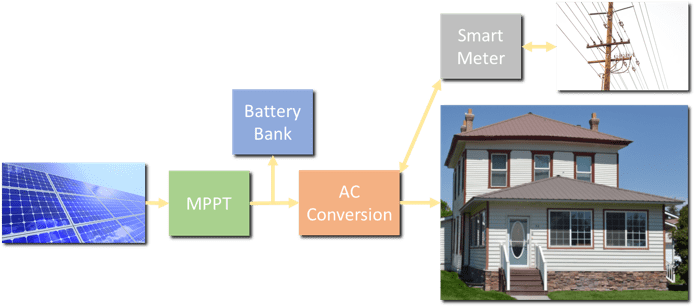
The solar panel array has a limited DC supply and it varies throughout the day depending on the sunlight. To extract maximum possible power from the sun, a technique known as maximum power point tracking is used within your solar inverter.
MPPT is simply just a DC to DC converter. The MPPT circuit within your solar inverter constantly detects the solar panel array DC voltage and current. Then, it adjusts the setting to extract maximum power and drive your solar inverter at the maximum possible efficiency.
If the solar panels within your solar panel array are mounted across the roof area in different directions, multiple MPPTs are needed. This is due to the amount of sunlight falling on each panel being different.
MPPT solar inverters are classified as single or dual inverters. Dual MPPT inverters are advantageous as they connect two or more strings without the need for a combiner box. Also, they efficiently handle different tilt angles, azimuth angles, and voltage and power differences.
Transformer-less Inverters REVEALED
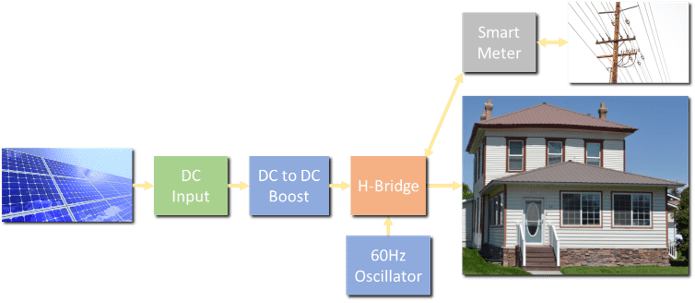
Today, transformer-less solar inverters are becoming popular. As no extra transformer is required, they decrease the extra weight, expense, and size. This sort of solar inverter is more productive as the misfortunes caused by the transformers are overcome – the efficiency is practically 97%.
This type of solar inverter uses a computerized multi-step process. As such, it converts the DC output of solar panel into high-frequency DC using a boost converter. Also, it’s converted into AC as per the grid and load requirement using an H-Bridge converter and oscillator.
Finally, the DC boost converter replaces the traditional step-up transformer. That means, it reduces the losses and space requirements.
Transformer-based Inverters EXPLAINED
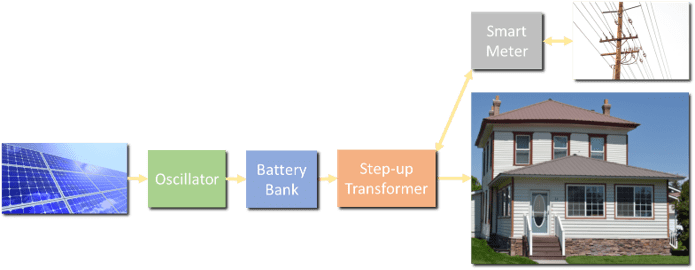
A conventional solar inverters is built with a transformer to synchronize the voltage of the grid and your household load. Then, the generated DC is converted into AC with the help of an oscillator and metal oxide semiconductor field-effect transistor or MOSFETs. Finally, the AC power is matched with the frequency of the grid/load with the help of a transformer.
Traditional solar inverters suffer from transformer losses. That means, efficiency is decreased. Also, the weight of these inverters is high leading to increases in transportation and installation expenses. To overcome these losses transformer-less multi-mode inverters are gaining in popularity.
Four hybrid solar system categories
Hybrid systems generally fit into one of four main categories. The first type is a basic hybrid inverter without a backup battery bank. Then, the multi-mode inverter allows for backup power. Next is the all-in-one Battery Energy Storage System or BESS. Finally, advanced AC-coupled systems are used in both hybrid solar and off-grid solar systems.
The most economical hybrid solar system uses a simple hybrid inverter that contains a solar inverter and battery inverter with a battery charger together with smart controls that determine the most efficient use of your available power.
The larger BESS systems basically use hybrid inverters together with lithium batteries in one complete system. They are usually about the size of a refrigerator. However, there are many capabilities and features that differentiate the wide variety of hybrid systems available.
Calculate your solar system size
Before you use an off-grid solar calculator, it’s critical to determine the amount of energy you and your family require. As such, calculate your daily energy usage throughout the year in detail. The reason for this is simple: off-grid solar systems are inherently variable – day vs. night and sunny days vs. cloudy days.
When you understand your daily and yearly power rhythms or usage curves, your family’s energy consumption comes into light. Then, you can plan for an efficient and reliable system. Using your household power usage data, calculate the adequate size of your off-grid solar system accurately.
Although your household energy usage varies throughout the year, calculate the basics in kWh (kilowatt hours). To begin, water usage, appliance usage, and general electricity usage is where to start. Keep in mind, only calculate water-usage if you use an electric water pump to provide water to your household.
Power usage of your home appliances in kWh
According to Energy.Gov’s article about estimating appliance and home electronic power usage, estimate total electricity used by your appliances with the following four methods:
- Review each Energy Guide label to estimate the individual unit’s average energy consumption.
- Use an Electric Consumption Meter to uncover how much electricity each appliance consumes.
- Install a whole-house energy monitoring system to monitor your actual energy usage.
- Calculate your total annual energy consumption using the formulas shown below.
Calculating your annual energy consumption
To accurately determine your annual energy consumption, calculate each appliance individually. As such, use the wattage value for each of your own electrical appliances and products. This will provide the most accurate estimate. Then, add them all together to calculate your total annual energy consumption.
Start by estimating the number of hours per day each electric appliance and product runs throughout the day. For example, estimate the number of hours you use each electronic device. Examples include TVs, computers, gaming systems, home audio, and so on. Then, calculate each based on the wattage stated on each label.
Determine your daily energy consumption by using this formula: (Watts × Daily hours used) ÷ 1000 = Daily kWh of consumption.
Calculate your annual energy consumption by using this formula: Daily kWh of consumption × Number of days used per year = Annual energy consumption.
According to the U.S. Energy Information Administration:
“In 2020, the average annual electricity consumption for a U.S. residential utility customer was 10,715 kilowatthours (kWh), an average of about 893 kWh per month. Louisiana had the highest annual electricity consumption at 14,407 kWh per residential customer, and Hawaii had the lowest at 6,446 kWh per residential customer.”