
If you’ve ever considered investing in your own home solar assets, now is the time to buy, and for many reasons. First, receive a 26% tax credit – it’s about to drop to 22% in 2023 and the future is unknown after that. Next, loan providers are growing and offering better rates than ever before. Finally, electricity rates are rising fast – see how to put a quick stop to rising electric bills.
As you’ll see, the benefits of owning home solar assets are quite numerous. Although electrical independence and electrical assurance are great motivating factors, other benefits stand out too – let’s look at both. Therefore, read on to uncover the benefits of investing in home solar assets revealed here.
Electrical autonomy from solar assets
Since the peace of mind that comes from electrical independence and unbroken electrical assurance is undeniable, we’ll take a good look at that. As you’ll see, electrical autonomy normally comes from off-grid solar systems. But if your home is connected to the power grid, a hybrid solar system is an even better option. Next, see why. Then, see a brief explanation of the most important solar system components.
Investing in hybrid solar assets – your best choice
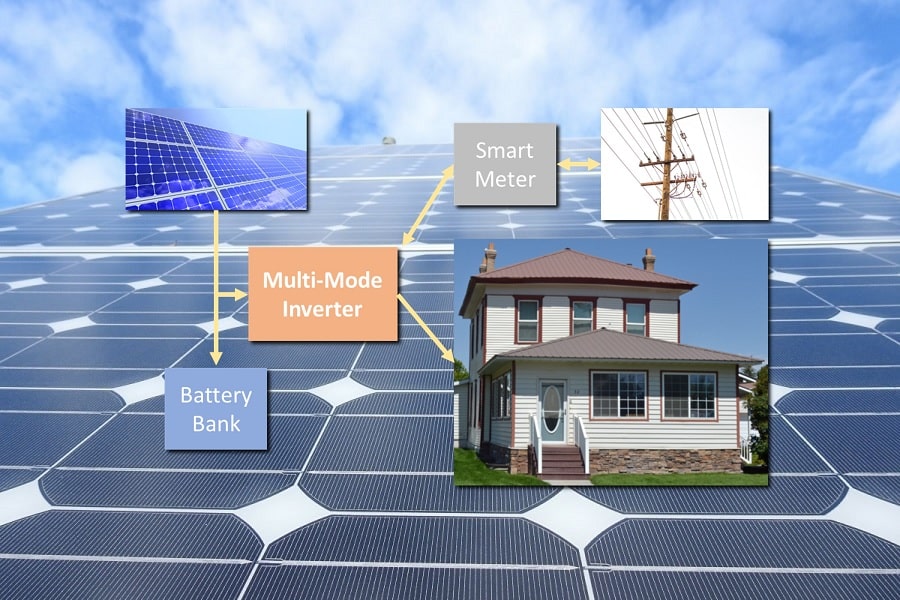
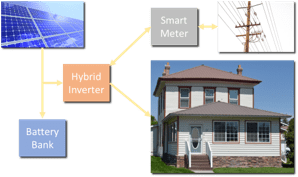
When referring hybrid solar assets, you’re talking about a self-sustaining household electrical system that is also connected to your local electrical grid. That means, this system provides three sources of electricity: solar power, battery bank power, and power from your local electrical grid.
Your local grid connection provides extra power when you need it. Also, it receives excess power produced by your solar system. That means, when your solar system produces excess power, your hybrid solar system becomes a “source” of power. Using a smart meter and a process called net metering, you receive credit on your bill for power that you export, explained next.
By replacing your electrical meter with a smart meter, you receive something called net metering. To elaborate, net metering is a process that analyzes and displays your local grid’s electrical imports and exports. Then, smart meters handle additional factors such as power generated by your solar system and power consumed. While exporting power, your smart meter accounts for it and credits are applied to your bill.
Finally, staying connected to your power grid allows you to receive unlimited electricity. That means, if you use big electrical equipment or high-electrical-current appliances, your electrical system will support it without fault. And if the summer heat steeply rises, use air conditioning to your heart’s content and stay cool throughout the day.
Brief explanation of solar assets within a system
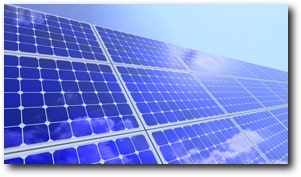
Your solar panel array contains photo-voltaic cells mounted together in a framework. To generate electricity, these panels use energy from sunlight called photons to generate DC electricity.
Hybrid solar inverters, also called multi-mode inverters, perform two functions. First, they convert DC from your solar panel array and battery bank to 120V AC for your household. Then, they manage battery charge levels to prolong battery life.
Off-grid home solar system asset investment
For a statistic, over 300,000 homes now use off-grid solar power systems for their total energy needs. As such, they’ve removed that electrical dependency by investing in their own reliable power source for their households. But of course, there are some hurdles to explore before proceeding. Let’s look at those…
The first hurdle is a lifestyle change. When speaking to those who use off-grid solar systems, they always offer one clear warning. They will tell you that relying on off-grid solar power requires life adjustments. To explain, you must reevaluate and adjust your relationship with electricity. But, you will live better for it!
After you’ve reevaluated your relationship with electricity, there are additional calculations and costs to acknowledge. First, determine how much energy your household requires by calculating your daily and yearly energy usage. Off-grid solar systems inherently vary depending on day vs. night, sunny seasons vs. cloudy seasons, and the changing angle of the sun throughout the year.
Finally, there’s a balance between your solar system size requirements and your electrical needs. In order to provide true unbroken electrical assurance, your battery bank must be quite large to get you through long periods of little to no sunlight. Also, a backup generator may be needed depending on your region.
Financial benefits of solar assets
The financial benefits that you gain from solar assets offset the upfront system costs. As mentioned, receive tax credits from the US Government. Right now, that credit is 26% of your total solar assets and installation cost. Unfortunately, that reduces to 22% in 2023 and the future of it is unknown after 2023.
Expect an increase to the value of your home after installing your own solar assets. You’ll not only be able to sell your home faster, but you’ll get considerably more for your home – your home appraisal will go up tremendously. Finally, solar assets provide a great hedge against inflation, just like home ownership does.
Receive higher monthly rent when leasing your home. This not only comes from your increased home value, but the greatly reduced or eliminated electric bill provides an attractive justification for increased rent. Then, when you add the environmental factor of solar power, your potential renter pool increases.
Additional money savings from a solar system
Sunlight is free, and the energy you can produce from that sunlight is almost endless. That being said, installing an effective and sufficient home solar system costs money. But, the money-saving benefits always come through in the end. As such, solar is an investment that really pays off.
Another way to save money on solar is to use a solar system broker like Just Get Solar. As an equipment broker, Just Get Solar eliminates the middle man, saving you those large commissions of 25% to 35%. On top of that, they get you the best equipment at the best prices and the best load rates, saving you even more.
As you’ve seen on your electricity bills, prices go up regularly. Compare that to monthly payments on your solar system loan. Obviously, loan payments do not go up and they eventually come to an end once paid in full. That means, you will no longer have an electric bill if your solar system is fully sufficient.
The amount you save on your electric bills when using solar power is directly proportional to the sufficiency of your solar system. To explain, if the your solar system is big enough to provide for all your electricity needs, your electric bill will drop to zero. On top of that, sell back your excess power by installing a hybrid solar system.
Short video revealing your solar asset benefits
In the following short video, Eric Martineau, the founder and owner of Just Get Solar reveals detailed insight about the benefits of having your own solar assets. There, uncover exactly how important it is to own your own solar system from actual data presented by Eric. Check it out!
As you can see, the benefits of purchasing your own solar system abound. Be sure to contact Just Get Solar to get a free quote.
Cover your solar assets with great financing options
Attractive financing options for solar assets have greatly contributed to the solar market recovery after the 2020 COVID-19 economic crisis. Now with high inflation and energy prices, homeowners are seriously looking to save money to avoid economic hardship. That means, financing your solar system offers immediate electric bill savings and it doesn’t require you to expend your precious cash reserves.
The recent expansion of available financiers and the solar loan market has greatly broadened. Also, this is a well-documented trend in the solar industry. On top of that, the overall strong performance of the solar asset class is quite a strong metric of success all by itself. That means, financing or not, solar assets win over using your local electrical grid to support your power needs.