


Now that people are drawn to achieve power independence, both off-grid solar systems and hybrid solar systems are a reality for many. Today, that can be a reality for you too! It all starts by using an off-grid solar calculator to determine exactly what equipment you need to accomplish this.
You can find a good off-grid solar calculator online, and we provide one too. But here, we’ll break down exactly what goes into that calculation. Knowledge is powerful, so equip yourself here before you buy an off-grid or a hybrid solar system. Read on to uncover how to calculate your off-grid solar system.
Determine your home power usage
Before you use an off-grid solar calculator, it’s critical to determine the amount of energy you and your family require. As such, calculate your daily energy usage throughout the year in detail. The reason for this is simple: off-grid solar systems are inherently variable – day vs. night and sunny days vs. cloudy days.
When you understand your daily and yearly power rhythms or usage curves, your family’s energy consumption comes into light. Then, you can plan for an efficient and reliable system. Using your household power usage data, calculate the adequate size of your off-grid solar system accurately.
Although your household energy usage varies throughout the year, calculate the basics in kWh (kilowatt hours). To begin, water usage, appliance usage, and general electricity usage is where to start. Keep in mind, only calculate water-usage if you use an electric water pump to provide water to your household.
Off-grid solar calculator: water pump power usage
If you use a water pump, check your water pump’s wattage – it’ll vary from 250W to 1,100W. Then, take the wattage of your specific water pump and multiply it by the number of hours per day that it runs. Finally, divide by 1000 for the amount of kWh used by your pump.
Power usage of your home appliances in kWh
According to Energy.Gov’s article about estimating appliance and home electronic power usage, estimate total electricity used by your appliances with the following four methods:
- Review each Energy Guide label to estimate the individual unit’s average energy consumption.
- Use an Electric Consumption Meter to uncover how much electricity each appliance consumes.
- Install a whole-house energy monitoring system to monitor your actual energy usage.
- Calculate your total annual energy consumption using the formulas shown below.
Calculating your annual energy consumption
To accurately determine your annual energy consumption, calculate each appliance individually. As such, use the wattage value for each of your own electrical appliances and products. This will provide the most accurate estimate. Then, add them all together to calculate your total annual energy consumption.
Start by estimating the number of hours per day each electric appliance and product runs throughout the day. For example, estimate the number of hours you use each electronic device. Examples include TVs, computers, gaming systems, home audio, and so on. Then, calculate each based on the wattage stated on each label.
Determine your daily energy consumption by using this formula: (Watts × Daily hours used) ÷ 1000 = Daily kWh of consumption.
Calculate your annual energy consumption by using this formula: Daily kWh of consumption × Number of days used per year = Annual energy consumption.
According to the U.S. Energy Information Administration:
“In 2020, the average annual electricity consumption for a U.S. residential utility customer was 10,715 kilowatthours (kWh), an average of about 893 kWh per month. Louisiana had the highest annual electricity consumption at 14,407 kWh per residential customer, and Hawaii had the lowest at 6,446 kWh per residential customer.”
Off-grid solar calculator ingredients
In order to understand how an off-grid solar calculator works, check out the following ingredients that go into it. In this section, equip yourself with important knowledge to calculate it yourself. That way, you won’t run into surprises when purchasing you own off-grid solar system.
Calculate your area’s potential solar power

Solar panel arrays require direct sunlight to produce maximum power output. Even on cloudy days, solar panels absorb solar energy and produce power. But of course, power output reduces significantly by 25% to 40% compared to sunny days.
To maximize the amount of sunlight your solar panel array receives, face them to the sun. Avoid installing them in shade under trees or nearby buildings. Although solar system installers help you determine the best placement for your panels, plot a sun chart. Use a solar tracker to determine how much sun your solar panels are likely to receive on a typical day.
Calculating the total sunlight your solar panel array receives is important. But a more accurate calculation is the amount of power your panels produce during peak sun-hours. First, peak sun hours are not the same as hours of daylight. Peak sun hours are the maximum solar energy available during a typical day. To be specific, a peak sun hour is an hour where intensity of sunlight is 1000W per square meter.
Factors that determine peak sun hours are time of day are as follows. To begin, noon is the highest level. Then, proximity to the equator gets calculated. Finally, each season is calculated – summer has the highest level. As an example, your solar panel array may receive an average of seven hours of sunlight per day, the average peak sun hours may actually be only three or four hours.
For a resource, NASA’s Power Project provides solar and meteorological data sets from NASA research. This is for support of renewable energy, building energy efficiency and agricultural needs.
Off-grid solar components REVEALED
While you may find many variations and custom options that go into an off-grid solar system, there’s an assortment of essentials to identify and explain in simple terms. As such, let’s take a walk through each part to understand the basic system and what essential solar components go into it prior to installation.
Create free electricity with solar panel arrays
A solar panel array is a framework of panels filled with photo-voltaic cells. They generate DC electricity from the energy projected by sunlight called photons. This process was first discovered by Alexandre-Edmond Becquerel back in 1839.
A term called “Panel Efficiency” deals with the electrical output of each panel: 320W, 290W, 270W etc. This translates into the number of panels you’ll need. To calculate, power rating divides by total panel area. That means, having a larger panel doesn’t always equate to higher efficiency.
Your solar panels must be compatible with the battery bank and power inverter packaged with your off-grid system. To make that happen properly, the voltage, amperage, and string size are all calculated prior to solar component selection. This prevents damage to your solar components and it ensures reliability when your off-grid solar system is in use.
Power optimizers improve solar panel reliability
Power optimizers maximize the energy harvest from solar power systems. They achieve this by individually tuning the performance of each panel within the solar panel array. As you’ll see, power optimizers are especially useful when the component performance in a distributed system varies due to shading or facing different directions.
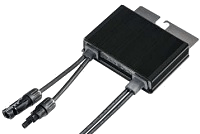
Shown here is a voltage converter that connects to each solar module in your solar panel array. In short, it turns them into smart modules. By constantly tracking the MPPT or Maximum Power Point Tracking of each individual solar module, power optimizers increase system energy production.
When you attach these power optimizers to each solar module, installers can easily monitor system performance reliably. In other words, installers will be able to track, pinpoint, and resolve issues at any point along a string with surgical precision. This lowers maintenance costs dramatically over the life of your system.
120V AC off-grid solar system inverter-charger
Knowing that your solar panel array and battery bank generate DC or Direct Current, the electricity must be converted into 120V AC or Alternating Current for your home. To explain, the electricity in your home must be 120V AC. In other words, your solar power inverter-charger creates power that mimics that normally coming from a utility grid.
In addition to providing 120V AC to the home, your inverter-charger is the heart and brains of your off-grid solar system. First, it regulates battery bank charging and manages battery charge levels to maintain battery life. Then, it monitors and displays power consumption and battery status to provide system status.
Household steady power from battery banks
Your battery bank provides complete electrical independence – it makes off-grid solar systems possible. To explain, it provides power at night when your solar panel array isn’t producing. Also, it provides extra power in those moments when power consumption spikes above what your solar panel array provides.
As you know, not having a grid connection means you need a reliable way to store the energy generated during the day for later use. Therefore, it’s critical to have a battery bank to store enough energy to get you through each night. Also, they must support off-peak production periods like cloudy days.
Traditionally, lead-acid deep cycle battery systems were the most common and reliable option for off-grid solar systems. Though a proven technology lasting over a decade, they must be kept at room temperature and not be discharged often. To explain, high temperatures, low temperatures, and fully draining lead-acid batteries internally damages and degrades them.
Many advantages of Lithium-ion battery banks
Your best battery option for your off-grid solar system is the lithium-ion battery bank, an advanced storage device optimized for long lifespan, fast recharge, and high efficiency. Most notably, they’ve become extremely popular for their high efficiency ranging from 92% to 98%.
Lithium-ion battery banks are compact, lightweight and scalable. On top of that, they provide flexible sizing for additional capacity down the road. In other words, lithium-ion batteries may be added in the future as you’re power needs increase or if you just increase power storage for more peace of mind.
One giant advantage of lithium-ion battery banks are their ability to sustain a low or partial charge levels for prolonged periods without negative effects. Compare this to sulfation that is a common problem with lead-acid batteries. Also, lithium-ion batteries provide high charge rates – charge times are up to 70% faster than lead-acid.
System size off-grid solar calculator
Now that you have a strong understanding of your annual household power consumption and your area’s annual peak sun hours, let’s calculate the required size of your off-grid solar system as a whole.
Calculate solar panel array quality and size
There is quite a range of solar panel performance levels based on quality. That means, higher quality translates into more power per square foot. Generally, individual solar panels vary between 150w to 345w per panel. It depends on the size and actual cell technology used to create each panel.
First, calculate the number of panels needed. Start by dividing your household hourly energy usage by the solar panel wattage. Do this for both low and high wattage options. To explain, this allows you to create a range of sizes. It’ll give you realistic expectations regarding available space on your property.
This will provide an estimate for the number of panels you need to generate adequate power. Then, a professional installer will determine the best angle for your solar panel array. Finally, your installer will determine how your solar panels should be arranged on your roof or other structures.
Off-grid solar calculator – your solar inverter size
For off-grid solar systems, multi-mode inverters must be used to handle total household power loads. They perform two primary tasks. As mentioned, it converts DC from the solar panel array and battery bank to 120V AC for the household electricity. On top of that, it charges and manages the battery bank charge levels to prolong battery life.
Multi-mode inverters backup very large household loads like air-conditioners, water pumps and heaters. Many of them provide high level of pass through power capability. Therefore, advanced solar power inverters don’t require separation of essential loads and non-essential loads.
Solar inverter sizes are rated in Watts. Installers use two primary factors to determine size. First, they calculate total power output of your solar panel array. Then, they calculate site-specific conditions – how much power your household uses.
The size of your solar panel array is the most important factor in determining the appropriate inverter size. As a general rule, the size of your inverter handle the DC rating of your solar panel array. If you’re installing a 6kW system, expect the proposed inverter to be around 6kW in kind.
Inverter manufacturers typically list sizing guidelines for solar panel array capacity inverters can be paired with. Find this info on their product specification sheets. Be sure that the size of your solar panel array paired with their inverter is within their stated guidelines. Otherwise, they may void their warranty.
Battery bank off-grid solar calculator
Since the sun doesn’t shine at night and many days will be cloudy, your battery bank must carry you through. Standard off-grid sizing calls for three days of autonomy. That means, when no power is generated by your solar panel array, your battery bank will only be down to 50% State-Of-Charge (SOC) after three days. In practice, that works out to more than three days of storage.
Generators are always recommended for power backup when using an off-grid solar system. Standard sizing is the balance between your battery bank and the frequency you need to use that generator. During winter, your battery bank will sometimes fall short. Therefore, a generator is recommended to bridge those gaps in sunlight.
Now, calculate the minimum battery capacity in AH or Amp Hours. First, take the watt-hours per day and multiply them by three days. This represents a 50% depth-of-discharge on your batteries. Then multiply by two and convert the kWh result into AH. This is done by dividing by the battery bank voltage (12V, 24V or 48V).