If you’re concerned about maintaining solar panels and solar systems, you’ve come to the right place. Good news! Relieve your concerns with one simple answer: solar systems only require limited maintenance. The reason is simple – there’s no moving parts and solar panels perform for decades.
Although maintaining solar panels and solar systems is limited, there is some required maintenance, revealed here. Also, there are ways to monitor your solar panels and solar system to ensure its performance. Therefore, read on to learn how to maintain your solar panels and much more.
Maintaining solar panels easily
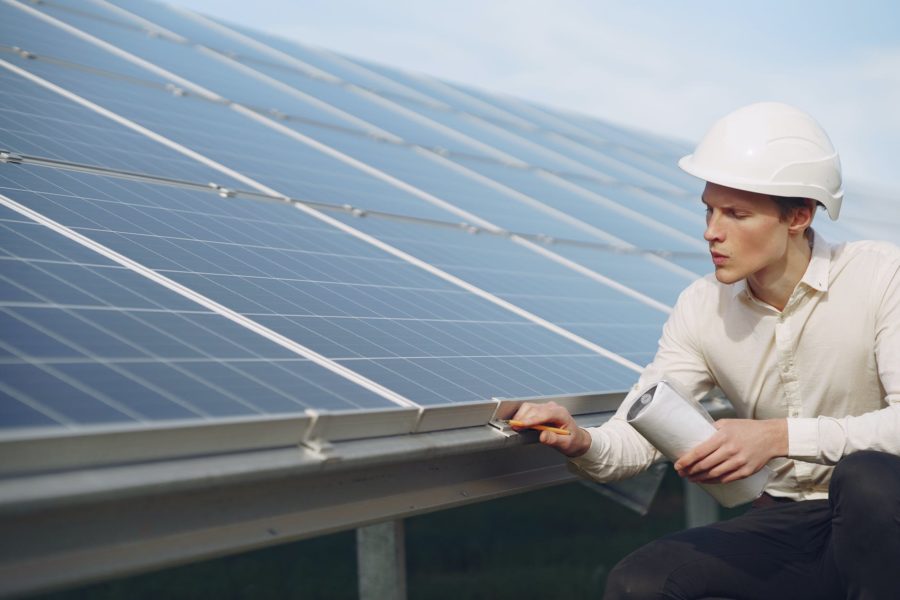
Your solar panels need very little maintenance to function properly. That means, you can leave them alone most of the time. Really, the only maintenance they require is an occasional light cleaning to remove dust, leaves, and debris that may be obstructing sunlight absorption. That’s it! Maintaining solar panels is simple indeed.
The only times you may need to perform more extensive maintenance is during and after heavy snowfall or after a dust storm. Snow and dust hinders solar panels performance by obstructing sunlight. Logically, if sunlight is obstructed, the electricity generated by your solar panels is reduced or brought to a halt.
If they’re tilted at an angle, maintaining solar panels is far easier. To explain, rainfall typically clears away dust, leaves and debris as the water runs down them. Just keep in mind that during the extended periods without rain, it’s important to clean your solar panels manually.
Clean your solar panels properly and effectively
Solar panel cleaning kits help you with maintaining solar panels. They come with biodegradable soap, a wiper, and a small brush or brush with a longer handle. Just mix the soap in a bucket with water. Then, dip the brush in the bucket and begin gently wiping your solar panels.
Generally speaking, clean your solar panels two to four times per year. Use a leaf blower or quickly spray them with a hose. But, clean them manually at least two times per year to remove residue that builds up on them.
Each solar panel within your solar panel array contains cells that are photo-voltaic. They’re connected in a framework to generate DC electricity. Amazingly, solar panels generate this power from the photons within sunlight.
Never use an abrasive sponge or soap or harsh materials to clean your solar panels. Fine scratches act like permanent sun filters that reduce electricity. As such, always use soft rags and biodegradable soap to clean your solar panels. The cleaner they are, the more electricity they’ll generate for your home.
Monitoring your solar system
Solar systems come with smartphone apps that monitor every aspect your solar system. They not only help you with maintaining your solar panels, but they also help you maintain your entire solar system. As such, continue reading to see how these smartphone apps work.
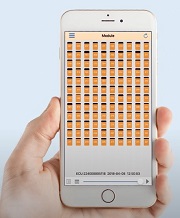
A smartphone app comes with your solar system that shows the performance of each solar panel in your solar panel array. To explain, it reveals both function and performance. That means, if one or more panels are dirty or have their sunlight blocked, you will see that on the app.
Monitor your solar panel performance whenever you open the app. Make sure to look open it regularly to catch problems early.
See your daily electrical production
Depending on the type of solar system you install, your daily production will be based on a few things. First, the free electricity coming in from the sun powers your home. Then, excess electricity generated by your solar panels charges your battery bank if you have one. Finally, export excess power is to the grid.
Through a process called “net metering,” electricity is both imported from the grid and exported to the grid. It depends on whether you need it or have extra to export. As you might guess, sell or export excess electricity to your local power grid. As such, you receive a credit from your utility company.
Each day, you can view a graph that shows your total daily electrical production. In it, you’ll see how much electricity is used by your household throughout the day. Then, you’ll see how much comes in from your solar panels. Finally, you’ll see how much electricity you import and export to and from the grid.
Solar system installation after financing for solar projects
First, never attempt to install your own solar system unless properly trained, experienced, and correctly certified to do so. In other words, this type of installation is not a DIY project. To explain, solar component installation and wiring requires an electrician and a construction contractor to do it right.
As a comparison, installing a complete solar system is like installing a circuit breaker unit with other major electrical systems. One primary component of a solar system is the solar power inverter, which powers your entire home. That means, safety and reliability is no different between the two.
Also necessary to install a solar system are construction skills. It requires skills to secure solar panel arrays to the top of existing structures. As such, those physical connections must be strong and reliable. Sometimes, structures are built from the ground up to sufficiently carry the load of those panels.
To find out how to find a great solar system installer, check out this detailed article:
SOLAR INSTALLERS NEAR ME: How to pick a solar installer to do it right
Two major solar systems
Peace of mind comes from solar energy independence and unbroken electrical assurance is an undeniable motivator. As such, solar energy independence comes from two types of solar systems: off-grid solar systems and hybrid solar systems. Hybrid solar is your best option if you have a local grid.
Multi-mode solar inverters, used in both types of solar systems perform two functions. First, they convert DC from your solar panel array and battery bank to 120V AC for your household. Then, they charge and manage battery bank levels to prolong battery life.
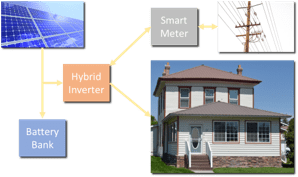
Solar energy independence from hybrid solar
When referring hybrid solar assets, you’re talking about a self-sustaining household electrical system that is also connected to your local electrical grid. That means, this system provides three sources of electricity: solar power, battery bank power, and power from your local electrical grid.
Keeping your connection to your power grid allows you to receive unlimited electricity. That means, if you use big equipment or appliances, your electrical system will support it without fault. And if the summer heat steeply rises, use air conditioning to your heart’s content and stay cool throughout the day.
Solar energy independence from off-grid solar
Starting with off-grid solar systems, over 300,000 homes use them for solar energy independence around the world. They know that when connected to the grid, they’re dependent on an external supplier, the utility company, for all their power. And when that power grid goes down, so does their power supply.
There’s a balance between your off-grid solar system size and your electrical needs. In order to provide true unbroken solar energy independence, your battery bank must be quite large. It must get you through long periods of little to no sunlight. Also, you need a backup generator depending on your region.
Check out this informative article to learn exactly how to calculate what must go into your solar system:
OFF-GRID SOLAR CALCULATOR: How to calculate an off-grid solar system size