

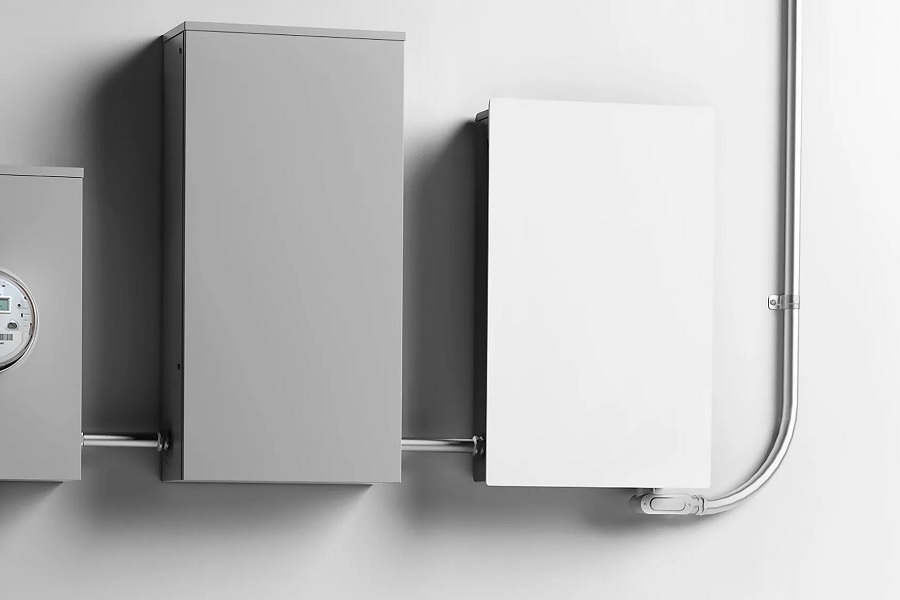
In short, a hybrid solar inverter converts DC or Direct Current into AC or Alternating Current used throughout your house. Why do you need a hybrid solar inverter? To keep it simple, solar panels and batteries use DC and your household uses 120V AC – they’re different and incompatible. That means, you must convert DC into AC using a hybrid solar inverter.
Now that you understand the need for a hybrid solar inverter, see where it fits in your hybrid solar system. Then, discover the best type available. Next, look at an overview and comparison between hybrid solar systems and off-grid solar systems. Finally, read a technical breakdown revealing how a hybrid solar inverter works.
Take a big sip of your coffee. Now, continue reading to uncover everything you need to know about hybrid solar systems. You’ll be well informed before investing in a hybrid solar inverter and solar systems in general.
What is your hybrid solar inverter?
Today, a hybrid solar inverter, also called a multi-mode inverter, performs two primary tasks. As mentioned, it converts DC from the solar panel array and battery bank to 120V AC for the household electricity. On top of that, it charges and manages the battery bank charge levels to prolong battery life.
Multi-mode inverters backup very large household loads like air-conditioners, water pumps and heaters. Many of them provide high level of pass through power capability. Therefore, advanced solar power inverters don’t require separation of essential loads and non-essential loads.
Another key function of a hybrid solar inverter is its ability to export excess solar energy to the utility grid. That means, excess electricity is sold back to your utility company when the sun is shining and your battery bank is fully charged. In other words, your solar system becomes a “source” of power for your area.
Where your hybrid solar inverter fits into the system
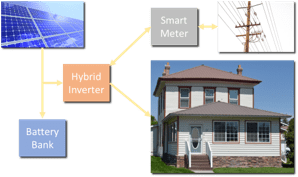
On the DC end of your hybrid solar inverter, it connects to your solar panel array and battery bank. Then, it connects to your house and power grid on the 120V AC end. To be specific, it connects to the power grid through your “smart meter,” explained below.
Although hybrid solar inverters connect to your power grid, they function as off-grid solar inverters when local power shuts down. That means, they can isolate from the grid during a power blackout. When a blackout occurs, they use your solar panel array and your battery bank together to provide continuous household power.
Off-grid solar vs. hybrid solar systems
To begin, there are many similarities between off-grid solar systems and hybrid solar systems. The primary difference is that hybrid solar systems connect to your local power grid. As you’ll see, there are some real advantages to using your power grid.
While both types of solar systems support household electricity independently, off-grid solar systems operate in this mode indefinitely. Therefore, they require much larger battery banks to support household power for long periods of time, like during cloudy periods.
To calculate the adequate size of your solar system, check out: OFF-GRID SOLAR CALCULATOR: How to calculate an off-grid solar system size.
Off-grid solar systems EXPLAINED
There are quite a few variations and custom options available for off-grid solar systems. As such, we’ll identify and detail the assortment of essentials in simple terms. Now, let’s walk through each part to see the basic system. Then, check out what essential solar components go into it prior to installation.
Before preparing your off-grid solar system, you must determine the amount of energy you and your family require. Off-grid solar systems are inherently variable – day vs. night and sunny vs. cloudy. As such, calculate both your daily energy usage and your usage throughout the year in detail.
The need to identify your daily and yearly power rhythms or usage curves of your family’s energy consumption is essential. This ensures an efficient and reliable system. Therefore, using your household power usage data, solar component size for your entire solar system will be adequate and accurate.
Keep this in mind: choosing to use an off-grid solar system requires lifestyle changes. Talking with off-grid solar system users reveals one thing. Off-grid power requires reevaluation and adjustment to your relationship with energy. Of course, they all say they live better lives because of it.
hybrid solar systems REVEALED
A hybrid solar system is self-sustaining. And, it’s a self-sustaining electrical systems also connected to your local power grid. To elaborate, it provides three sources of electrical power: solar power, battery bank, and your local electrical grid connection.
The advantage of using your local electrical grid connection is it provides power when you need it. On top of that, sell back excess power produced by your solar system. To explain, your hybrid solar system becomes a “source” of power for your city.
Using a smart meter and a process called net metering, you receive credits for that excess electricity you provide. This greatly reduces your bill and sometimes provides a net profit. That means, if your household uses less electricity than your hybrid solar system generates each month, you get paid.
Hybrid solar systems ensure you’ll always have power, no matter what. To explain, your house will have reliable power regardless of the weather or power outages in your region. That means, peace of mind is your number-one benefit from this self-reliant household electrical setup.
Clean 120V AC power technical brief
Clean 120V AC power is the name of the game when it comes to quality inverter output. When you look at the electricity provided by a power grid, the electrical waveform shows up as a pure 60hz sign wave. This waveform alternates between positive and negative 60 times per second, which is where the name Alternating Current comes from.
When the waveshape is smooth, current draw from appliances is smooth as well. This affects efficiency, power-supply temperature, and power-step response, like when the refrigerator compressor turns on. In simple terms, it allows equipment to operate under optimal conditions and provides much longer life.
If you use audio equipment, a quality power inverter is a must. Cheaper units produce a more jagged 60hz wave shape, which not only reduces those aspects mentioned earlier, but they also produce noise. Audio must be clean and noise free, so keep this in mind when picking your hybrid solar inverter.
Complete solar system installation
To begin, never try to install your own solar system unless properly trained, experienced, and correctly certified to do it. In other words, this type of installation is not a DIY project. As you’ll see, solar component installation and wiring requires an electrician and a construction contractor to do it right.
To compare, when you install a complete solar system, it’s like installing a circuit breaker unit along with other major electrical systems. As such, there is no difference between the two regarding safety and reliability. The safety of your family depends on your installation being done right.
Also a necessity, installing a solar system requires construction skills. As an example, solar panel arrays are normally connected to the top of existing structures. As such, those physical connections must be strong and reliable. Also, structures are sometimes built from scratch to carry the solar panel array load sufficiently.
According to the Office of Energy Efficiency & Renewable Energy, “Industry-standard certifications are awarded through organizations like North American Board of Certified Energy Practitioners (NABCEP).” These are widely recognized as the gold standard among renewable energy system installers.
To see how to find a great solar system installer, check out SOLAR INSTALLERS NEAR ME: How to pick a great solar installer