
If you’ve been wondering how solar panels work, you’ve come to the right article. Solar panel technology comes from individual PV or photovoltaic cells. They generate DC or Direct Current electricity when exposed to sunlight. Now that you’ve read the basic description, let’s dive even deeper…
Here, we’ll take a technical look at how solar panels work. Then, check out your available solar panel options in the market. As you’ll see, solar panels are a solid technology with variance in efficiency and power options that affect price. Therefore, read on to learn the facts and equip yourself before you buy.
How solar panels work in detail
PV solar panels use semiconductor technology to convert energy from sunlight into DC electricity to power your home. So to explain how solar panels work, they take advantage of one of nature’s most powerful yet free resources. Also, solar panels generate clean, emission-free electricity to power your home all year round.
On top of being a clean technology, solar panels have a long life span. In fact, they usually last more than 25 years, making them a good long-term investment. Also, solar panels reduce your energy bills.
For a brief history, Alexandre-Edmond Becquerel first discovered how solar energy works in 1839. To explain, he saw the ability of some materials to create an electrical charge from light exposure – this is exactly how solar panels work! Then, Russell Ohl designed solar cells used in modern solar panels in 1939. He patented that in 1941.
After 1941, modern solar panels became a stable and effective technology for the marketplace. That means, they worked great and they haven’t changed very much since then. Although their efficiency has gone up a little, from 18% to 22% on the high-quality end, it means that the technology is quite stable.
See how solar panels work technically
In a nutshell, how solar panels work technically is they generate electricity when particles of light called photons hit them. Those photons collide with electrons within the atoms of PV cells. This moves them into electric current flow. That flow becomes usable electric DC current. This is the PV effect – the foundational process behind solar panel technology.

Technology behind how solar panels work
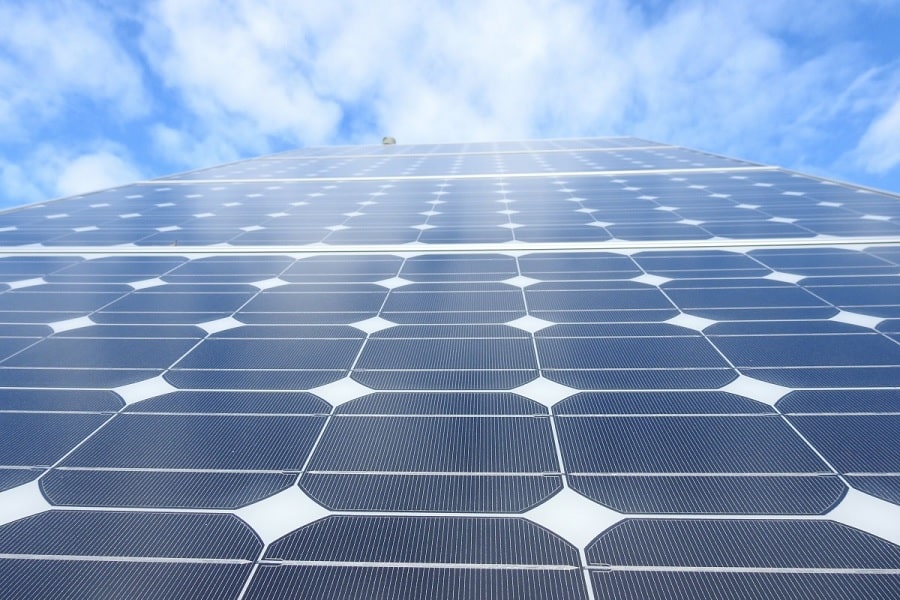
To see how solar panels work on the inside, they each comprise silicon-cell layers. Then, a metal frame and a glass casing surround them. For maximum effect, solar panels group together to form a solar panel array or an ordered series. Finally, solar panel arrays mount to rooftops or outdoor structures placed in an open area.
Inside of each solar cell, there’s a thin semiconductor wafer made from two layers of silicon. One layer has a positive charge and the other a negative charge, forming the electric field. When sunlight strikes a PV solar cell, it causes electrons to flow as DC electricity.
Elements that make up solar panel technology
The silicon used in solar panels is a non-metal semiconductor. It is the material that absorbs and converts sunlight into electricity. The two main semiconductor silicon materials used in solar panel production are cadmium-telluride and copper indium gallium diselenide.
PV cells comprise two layers of semiconductor silicon. Each treated to create an electric field between the layers. This electric field forces electrons to flow through the solar cell and out of the silicon, generating a DC electrical current. Phosphorus and boron treat each layer prior to bonding them together.
Metal plates on the sides of each solar cell collect the electrons pushed out by the electric field. Then, the DC electricity created from that electric field transfers to connecting wires. At this point, the DC current flows through the wiring to a solar inverter and then throughout your home.
Alternatives to using silicon-semiconductors
Although silicon is the most common solar panel semiconductor used worldwide, there are alternatives to consider. To begin, thin-film solar cells comprise lightweight and flexible materials. As such, there are four main chemical types of thin-film solar cells: CIGS or Copper Indium Gallium Selenide, CdTe or Cadmium Telluride, a-Si or Amorphous Silicon, and GaAs or Gallium Arsenide. Light-absorbing layers within these cell types are 350 times smaller than silicon cells, hence the name “thin-film.”
Next are perovskite solar cells. These are a class of man-made materials with unique crystallographic structures that makes them highly efficient at converting photons of light into usable electricity. Interestingly, perovskite cells are created using the same type of process used to print newspapers.
Lastly, organic solar cells comprise a separate type of thin-film solar cell using carbon-based materials. These are called OPVs or Organic PVs and are also sometimes referred to as “polymer solar cells” or “plastic solar cells.” They’re produced by dissolving organic compounds in ink. Then, they’re printed onto thin plastics or polymers.
Bifacial panels REVEALED
Bifacial panels have solar cells on each side. These are high-end panels since there is no plastic back sheet on the back of the panel. To compare, some lower-end panels use a back sheet that can peel away from the panel over time.
Particularly valuable in cold climates, bifacial panels allow the back side to produce electricity. This is valuable when the top of the solar panel array is covered with snow. The resistance of the electricity moving through the back side of the panel produces heat, which helps to melt the snow.
When viewing the bifacial panel laboratory Wattage, please note that it only refers to the front side of the panel. To calculate the total laboratory Wattage for both sides, multiply the front side Wattage by 1.05 if the panel is placed on a roof OR by 1.15 if it is placed on a ground mount rack.
Split-cell panels EXPLAINED
To describe split-cell panels, they have a bus bar right in the middle of the panel. Also, they’re considered higher-end panels since the electric current travels a shorter distance than it does in a regular panel. That means, they have an increased solar panel life. On top of that, shading on one side of the panel doesn’t affect the other performance of the other side of the panel.
Solar panel label spec sheet details
On a solar panel spec sheet, the open circuit or short circuit ratings refer to one panel by itself, and the maximum power ratings refer to panels connected in a string. Typically, the 80% factor is applied to the Maximum Power Current shown on the spec sheet or panel label. This determines the actual amperage.
The amperage directly effects Wattage, so your actual Wattage will typically be about 80% of laboratory Wattage or less. Voltage increases as temperature drops, so those in colder climates should use the Voc or Voltage Open Circuit rating as stated.
If you live in a warmer climate like Arizona, plan to use about 90% of Voc. This is only if you are certain your ambient temperature never gets below 20 degrees F. This can cause your upper input Voltage limit to be exceeded. If that happens, the inverter will throw a fault code. Keep in mind, long-term over-Voltage fault codes may damage your inverter.
How solar panels work: INVERTERS
Solar inverters, also called a multi-mode inverters, perform two primary functions. First, they convert DC from the solar panel array and battery bank to 120V AC for your household electricity. Then, they charge and manage your battery bank to prolong battery life.
A multi-mode inverter backs up very large household loads like air-conditioners, water pumps and heaters. Many types of them provide high level of pass through power capability. Therefore, these solar power inverters don’t require separation of essential loads and non-essential loads – they handle them all.
Another key function of a solar inverter is its ability to export excess solar energy to the utility grid. That means, sell back any excess electricity generated by your solar system to your utility company. In other words, your solar system becomes a “source” of power for your area.
Where your solar inverter fits into the system
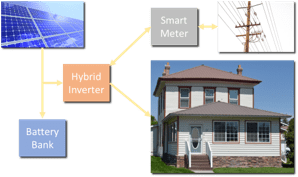
On the DC electric end of your solar inverter, it connects to your solar panel array and battery bank. Then, it connects to your house and power grid on the 120V AC end. To be specific, it connects to the power grid through your “smart meter,” explained below.
Although hybrid solar inverters connect to your power grid, they function as off-grid solar inverters when local power shuts down. That means, they can isolate from the grid during a power blackout. During a blackout, they use your solar panel array and your battery bank together to provide continuous household power.
To calculate an off-grid solar system, check out this great article detailing how:
OFF-GRID SOLAR CALCULATOR: How to calculate an off-grid solar system size
Battery banks store backup power
To achieve complete electrical independence, your battery bank powers your home at night and during cloudy days. Also, if your power grid goes down, you’ll continue to have household power fed by your battery bank. That saves you money on your utility bill simply by not using that power.
Throughout history, lead-acid deep cycle batteries have been the most common and reliable option for solar system backup power. The reason for that is simple: lead-acid batteries are a proven technology. First, they last well over a decade when kept at room temperature and not discharged often.
Lithium-ion batteries – your best option!
As the heading states, a lithium-ion battery bank is truly your best option available. To explain, it’s an advanced storage device optimized for long lifespan, fast recharge, and high efficiency. Most notably, lithium-ion batteries have become extremely popular for their high efficiency ranging from 92% to 98%.
Lithium-ion battery banks are compact, lightweight and scalable. Additionally, they provide flexible sizing for additional capacity in the future. In other words, add more in the future as your power needs increase. Or, increase your battery bank storage for more peace of mind.
Battery longevity is another great advantage to using lithium-ion battery banks. To explain, they have the ability to sustain a low charge level or a partial charge level for prolonged periods without negative effects. To compare, lead-acid batteries exhibit sulfation when not kept fully charged.
The final advantage to lithium-ion batteries is this: they provide high charge rates, with charge times up to 70% faster than that of lead-acid batteries. As you can see, lithium-ion battery banks are definitely your best option for household backup power.